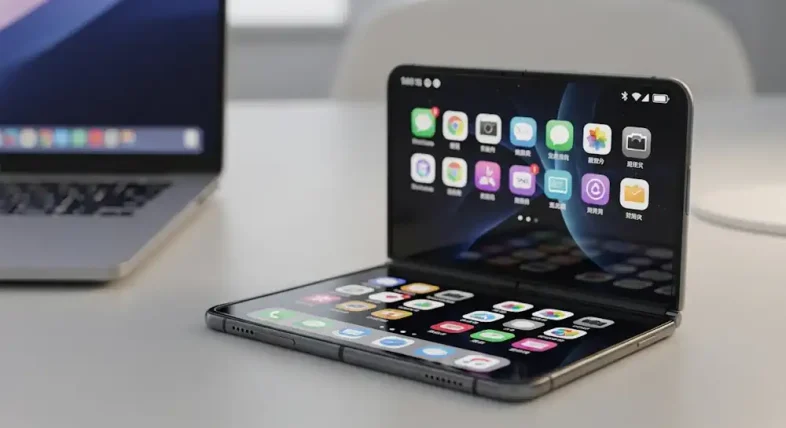
Foldable smartphones are entering a new phase. After years of iterative improvements to two-panel designs, manufacturers are moving toward tri-fold devices that aim to merge the smartphone and tablet experience more completely. With Samsung preparing to debut its first tri-fold phone before the end of 2025 and Apple advancing development of its first foldable iPhone, the next generation of mobile form factors is taking shape.
From Novelty to Mainstream
In a few product cycles, foldable devices have progressed from niche experiments to mainstream premium products. Models such as Samsung’s Galaxy Z Fold and Google’s Pixel Fold have shown that flexible OLED displays can survive daily use while delivering new multitasking options and compact portability. The latest Pixel 10 Pro Fold illustrates how thinner frames, stronger hinges, and improved water resistance can make foldables practical for everyday users.
Industry watchers see the segment maturing as hardware reliability improves and prices stabilize in the high end. Even as two-panel foldables gain traction, leading brands are investigating the next step that could redefine portable productivity and entertainment.
The Tri-Fold Concept
A tri-fold, sometimes called a multi-fold, uses three display sections connected by two hinges. When fully opened, it offers a much larger screen that approaches tablet dimensions, yet it folds down to a pocketable size. The concept is designed to combine versatility with productivity, allowing users to shift between compact phone use and expansive canvas modes for work or media.
The potential benefits include a larger display area, flexible posture options, and improved multitasking with multiple active panels. The challenges are substantial as well. Additional hinges introduce mechanical complexity, battery placement must be balanced across three segments, and keeping the device thin and light is difficult. Costs rise because more moving parts increase production risk and material requirements.
Samsung’s Tri-Fold Ambitions
Samsung has stated that its first tri-fold smartphone is slated to arrive before the end of 2025. While final branding remains undecided, reporting points to Galaxy Z TriFold or Galaxy G Fold as likely names. The company’s goal is to showcase a device that meaningfully expands the use cases beyond current dual-panel foldables.
Leaked design materials suggest a U-shaped inward folding structure that protects the main display inside when closed. Several reports describe three battery cells distributed across the panels for better weight balance. Rumors point to an unfolded display close to 10 inches, which would be larger than existing foldable phones and would effectively create a compact tablet experience.
Samsung is reportedly considering a limited production run to gauge market response, paired with a top-tier chipset and a version of One UI optimized for multi-panel layouts. Pricing is expected to sit in the ultra premium tier, reflecting the engineering complexity and component costs. Analysts also note that launch timing and market coverage could shift based on yields and demand.
Apple’s Approach To Foldable Design
Apple is preparing its own entry into foldables, with a first model expected to use a conventional two-panel book style. Industry reporting points to a 2026 debut that could align with the iPhone 18 cycle. The design path emphasizes a thin profile, structural rigidity, and a hinge that maintains uniform display tension during repeated folds.
Prototypes are said to pair an outer screen around the size of a compact phone with an inner display that approaches small tablet dimensions. Materials research reportedly includes a titanium and aluminum frame to balance strength and weight. Apple has initiated test production to refine manufacturing steps before scaling to mass assembly. Pricing is expected to be premium, consistent with the company’s position in the high end of the market.
Competition And Global Impact
Samsung and Apple are not alone in pushing foldable innovation. Huawei already sells a tri-fold device in China, and brands such as Vivo, Xiaomi, and Oppo continue to iterate on flexible hinges and display stacks. This competition could accelerate improvements in ultra-thin glass, hinge longevity, and battery density, which are pivotal for multi-fold designs.
Software optimization remains a critical piece. Android and iOS continue to refine window management and continuity features so that apps adapt instantly as users switch between folded and unfolded modes. As platforms and apps better recognize intermediate postures, tri-fold devices could unlock new workflows that go beyond simple split-screen arrangements.
What Comes Next
The next year will test whether tri-fold smartphones become a lasting category or remain a technical showcase. Samsung’s first model will offer an initial proof of concept at scale, while Apple’s foldable roadmap could set expectations for durability, performance, and software polish. If both approaches resonate with consumers, foldables may further blur the lines between phones, tablets, and lightweight laptops.
For buyers, the practical questions will revolve around price, weight, battery life, and app behavior in complex layouts. If manufacturers can deliver on these fundamentals, tri-fold devices could become the most versatile mobile computers yet, expanding or contracting to suit work, creativity, and entertainment in a single pocketable product.