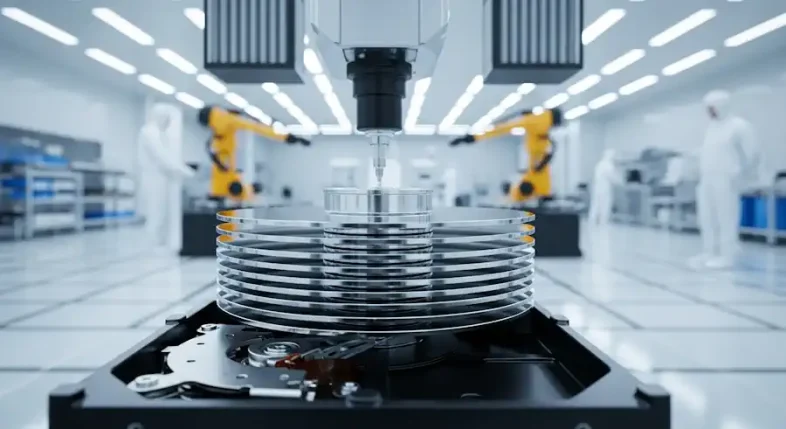
Toshiba is pushing hard-disk technology forward with a 12-platter design in a standard 3.5-inch form factor, a step the company says will underpin 40 TB-class drives targeted for around 2027. The approach leans on thinner glass platters and refinements to existing recording methods to raise capacity without changing rack compatibility. For data center operators balancing cost, density, and reliability, the move signals renewed headroom for mechanical storage in an era dominated by flash headlines.
While the roadmap still has milestones ahead before commercial launch, the engineering validation points to practical gains that could arrive within typical enterprise refresh cycles. The development also underscores that hard drives remain central to exabyte-scale archives, backup tiers, and warm data pools where dollars per terabyte rule the day.
What Toshiba Announced
The centerpiece is a verified 12-disk stack fitted inside the familiar 3.5-inch enclosure used across nearline enterprise drives. Adding two platters over today’s common 10-disk configurations increases the number of magnetic surfaces available for data, enabling higher capacities without a new chassis or bay footprint. Toshiba pairs the mechanical redesign with microwave-assisted magnetic recording, an approach it has already deployed to raise areal density.
The company is targeting 40 TB-class drives based on this architecture. That capacity tier would give storage builders a straightforward path to lift total rack density while preserving cabling, carriers, and airflow expectations set by current platforms.
How 12-Platter Design Works
Moving from 10 to 12 platters sounds simple, but it forces changes throughout the drive. The platters themselves must be thinner and more rigid to fit neatly within the same vertical stack while maintaining tight tolerances. Glass substrates are a natural fit because they can be manufactured thinner than aluminum yet hold their shape, which supports stable head flying height and lowers wobble under vibration.
Beyond the platters, the spindle motor, head stack assembly, and actuator mechanics must handle additional mass and surfaces without compromising reliability. Firmware tuning also plays a role, coordinating seek behavior and write strategies to account for more surfaces and the thermal profile of a denser interior. The use of microwave-assisted techniques helps write smaller magnetic domains consistently, extending the practical life of conventional perpendicular recording.
Why It Matters For Data Centers
Enterprises with thousands of bays see capacity gains ripple through power, cooling, and floor space budgets. A higher-capacity drive reduces the number of units required for a target petabyte, trimming enclosure counts and auxiliary hardware while preserving throughput at the system level. Those effects compound in hyperscale deployments where incremental density improvements translate to sizable operating expense savings.
Mechanical storage also keeps a strong hold on archive and warm tiers because it delivers favorable economics for large, sequential workloads. As AI pipelines and content platforms generate ever-larger datasets, operators prefer to keep more information online for longer. Bigger drives help maintain that posture without a proportional rise in rack footprints.
- Higher density per bay – better dollars per terabyte at rack scale.
- Familiar 3.5-inch form factor – minimal integration friction.
- Glass platters and refined mechanics – reliability aligned with enterprise duty cycles.
Competitive Landscape And Timeline
The broader market is pursuing multiple routes to higher density. Some vendors emphasize heat-assisted magnetic recording to push areal density further on fewer platters, while others refine existing methods to de-risk manufacturing and speed validation. Toshiba’s 12-platter strategy falls into the latter camp, trading bleeding-edge recording for mechanical ingenuity and platform continuity.
Timing will be closely watched. Verification of a stacked design is a key milestone, but commercial drives still require extended reliability testing, qualification with system partners, and firmware tuning for mixed workloads. A 2027 availability target places the products within the window of many data center refresh plans, yet competitive launches could shape buying decisions if larger capacities or earlier ship dates materialize elsewhere.
Operational Considerations
Adopting denser drives is not only a capacity decision. Operators weigh vibration behavior in high-fill enclosures, rebuild times in large arrays, and the interplay between drive count and failure domains. As capacities climb, strategies such as erasure coding, multi-actuator architectures, and domain-aware rebuilds help mitigate longer recovery intervals and preserve service levels.
Power and cooling profiles also matter. Modern nearline HDDs continue to improve idle and active power characteristics, but rack-level planning must account for thermal density as bays fill with higher-capacity models. The benefit of staying in a known 3.5-inch thermal envelope is that airflow, backplanes, and carriers are already optimized for similar loads.
What To Watch Next
Between now and general availability, expect incremental updates on manufacturing readiness, qualification progress with storage system vendors, and any roadmap signals around pairing the 12-platter platform with future recording enhancements. Real-world benchmarks in dense enclosures will be especially telling for vibration tolerance and sustained performance under mixed workloads.
If the 12-platter architecture meets reliability targets and ships on time, it would extend the cost advantage of hard drives at scale and give operators a clear path to higher density without disruptive hardware changes. In a market where capacity economics govern architecture choices, that kind of continuity can be as valuable as raw terabytes.